

 Dec 16,2025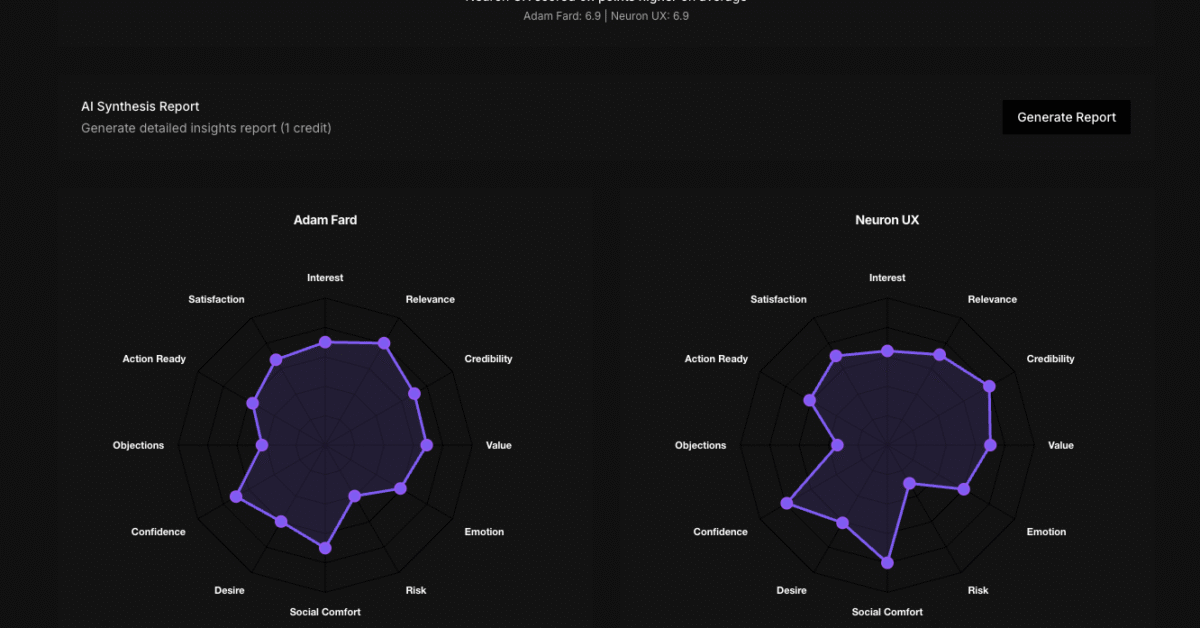
We tested Adam Fard Studio against Neuron UX using 7 startup founders who just secured funding for their SaaS products. Both agencies target this exact audience. Both showcase impressive portfolios and enterprise clients. The test ran for 8-10 minutes and revealed a positioning problem neither agency addresses.
Neuron UX scored 7.1/10 overall. Adam Fard scored 7.0/10. Neither number indicates founders felt ready to reach out. The scores show what’s actually breaking conversion: enterprise credibility creates psychological distance that stops action cold.
| Metric | Adam Fard Studio | Neuron UX |
|---|---|---|
| Overall Score | 7.0/10 | 7.1/10 |
| Action Readiness | 5.7/10 | 6.3/10 |
| Credibility Assessment | 7.0/10 | 8.0/10 |
| Relevance Recognition | 7.7/10 | 7.1/10 |
| Main Friction Point | Information overload from too many case studies | Hero image showing casting app contradicts B2B positioning |
| What Worked | Specific metrics (78% conversion increase, satisfaction 3→8) | Enterprise client logos (Intuit, LinkedIn, Palo Alto Networks) |
| Critical Insight | “The enterprise client logos are impressive but also make me wonder if they’d give a 15-person company the attention we need.” | |
| View Full Dashboard → | ||
The Founders We Tested
We selected 7 personas from Evelance’s database matching a specific profile: startup founder or co-founder who secured funding to launch their SaaS product. CEOs, CTOs, and product leads carrying funding pressure, hiring decisions, and the weight of choosing vendors who understand companies at their stage.
Ages ranged from 26 to 41 across San Francisco, Austin, New York, Chicago, Denver, Boston, and Seattle. Income levels spanned $82,000 to $220,000. Every persona held graduate degrees and high technical literacy. Each one was actively evaluating agencies or preparing to make that decision within the next quarter, which means they needed to choose quickly and justify that choice to co-founders or investors.
What We Measured
Evelance tracked responses across 12 psychological dimensions that predict conversion behavior. The first six metrics measure core evaluation:
Interest Activation tracks whether the design captures attention immediately. Relevance Recognition measures if founders see themselves in the positioning. Credibility Assessment scores trust in each agency’s claims. Value Perception reveals whether founders understand what they get for their money. Emotional Connection tracks resonance beyond functional evaluation. Risk Evaluation measures concerns about choosing the wrong agency.
The remaining six dimensions map the decision journey: Social Acceptability, Desire Creation, Confidence Building, Objection Level, Action Readiness, and Satisfaction Prediction. Each persona provided detailed feedback explaining their scores, revealing not just what founders thought but why they thought it and what psychological barriers stopped them from acting.
The Results
Neuron UX edged ahead by 0.1 points, but individual metrics tell the real story. Credibility Assessment favored Neuron UX at 8.0/10 compared to Adam Fard’s 7.0/10. Enterprise client logos created immediate trust. Intuit, LinkedIn, Palo Alto Networks, plus Clutch badges and external validation, reduced perceived risk substantially.
Relevance Recognition scored higher for Adam Fard at 7.7/10 versus Neuron UX’s 7.1/10. Specific outcome metrics landed hard with founders. “78% increase in conversion rate” and “satisfaction score from 3 to 8” gave concrete evaluation criteria that matched the metrics founders use internally.
Action Readiness revealed the conversion problem. Adam Fard scored 5.7/10 while Neuron UX reached 6.3/10. Both numbers sit below the threshold where founders actually reach out. The gap between recognizing quality work and feeling compelled to act remained wide for both agencies.
Download the Synthesized PDF
What Killed Credibility For Neuron UX
A casting app for models appears in Neuron UX’s hero animation. The page claims B2B workplace product expertise. Six out of 7 founders noticed the contradiction immediately and questioned whether the agency understands enterprise tools at all.
A New York CEO captured the problem: “The hero shows a casting app for models which immediately makes me question if they really understand B2B enterprise tools or if that’s just a portfolio piece.” A Denver founder stated it more directly: “The hero image showing a casting/modeling app throws me off immediately. I’m a B2B SaaS founder, not in entertainment. That disconnect makes me question whether they really get my space.”
The visual mismatch created cognitive dissonance that undermined every credibility signal below it. Client logos and case studies couldn’t fully overcome the doubt created by one visual choice. First impressions override faster than any downstream credibility recovery can fix.
What Overwhelmed Founders On Adam Fard
Every single founder mentioned feeling buried under case study volume on Adam Fard’s site. The content quality was high, but the presentation created decision paralysis instead of confidence.
A San Francisco CEO described the experience: “The page feels dense and a bit overwhelming. There’s a LOT of case studies which is good for credibility but I’m scrolling through so much content to figure out if they’re right for my specific situation.” A Boston CEO connected this directly to hesitation: “This feels like an agency that knows what they’re doing but hasn’t quite figured out how to present themselves cleanly.”
Founders needed quick confidence builders before committing to deeper evaluation. The comprehensive approach traded depth for decision speed and lost the conversion moment. Substance existed but remained trapped under volume that made scanning impossible.
The Conversion Killer Both Agencies Missed
A 32-year-old CEO from Denver scored Neuron UX at 7/10 and revealed the barrier stopping action:
“The enterprise client logos are impressive but also make me wonder if they’d give a 15-person company the attention we need.”
This tension appeared across every demographic and income level we tested. Enterprise social proof builds credibility while simultaneously creating psychological distance. Founders see Fortune 500 logos and immediately calculate whether they matter enough to receive similar attention and care.
A 41-year-old CEO from New York articulated the same concern about Adam Fard: “The enterprise examples are great but make me wonder if I’m too small for them or if they’d actually give us attention.” The psychological gap between “these seem capable” and “I should reach out now” never closed for either agency.
Neither site addressed company stage fit directly. Both relied on enterprise logos to build trust without acknowledging that this same proof point triggers anxiety for smaller companies. Founders want validation that the agency serves companies at their stage, not just billion-dollar corporations with massive budgets and internal teams.
What Actually Built Confidence
Adam Fard’s specific outcome metrics cut through generic promises completely. “78% increase in conversion rate” and “Customer satisfaction score from 3 to 8” provided concrete evaluation criteria. An Austin CTO explained why these numbers mattered: “Those are the kinds of numbers I’d actually reference when making a decision.”
Video testimonials from identifiable people with real titles created stronger trust than text quotes. A San Francisco CEO mentioned “Video testimonials from real people with titles I recognize” as building confidence. Visual proof of humans using the product overcomes skepticism that text alone cannot address.
Neuron UX’s free 5-week course addressed action readiness without forcing immediate sales conversations. A Boston CEO appreciated this approach: “Shows they’re thinking about building relationships not just closing deals.” The course reduced psychological barriers for founders who needed time to evaluate before committing to vendor discussions.
Client roster quality mattered when relevant to the founder’s stage. Logos from Listrak, Vendr, and Acuity resonated more than Fortune 100 brands because these companies represented achievable scale. A Denver CEO noted: “The Listrak and Vendr case studies are more relevant to what I’d need” compared to enterprise examples that felt distant.
Why Traditional Research Can’t Capture This
Recruiting 7 startup founders who just secured funding takes weeks. These founders drown in decisions about hiring, product roadmaps, and burn rates. Convincing them to spend an hour in interviews about agency websites requires incentives, scheduling coordination, and multiple follow-ups that delay insights when you need them immediately.
The research process itself introduces bias that corrupts the data. Founders in interviews feel pressure to articulate rational reasons for their reactions. They explain credibility concerns or information density without surfacing deeper psychological barriers. The quote about enterprise logos creating distance emerged naturally in written feedback. That insight never surfaces in structured interviews where founders optimize their feedback to be helpful rather than honest.
Traditional research also struggles with comparison testing at scale. Showing founders two agency sites back-to-back and asking them to evaluate both requires significant time investment. Psychological state changes between evaluations. Fatigue sets in. The authenticity of second evaluations suffers because founders remember what they said about the first site and adjust their feedback for consistency.
Evelance captured reactions in context. Each persona evaluated both sites as they naturally would: quickly scanning, forming impressions, deciding whether to dig deeper or move on. The 9-minute timeline reflects actual user behavior better than hour-long interviews that force artificial depth and manufacture insights that don’t exist in real evaluation moments.
What Both Agencies Need To Fix
Enterprise positioning delivers credibility and distance in equal measure. Founders need both proof of capability and proof of fit. A single section titled “We Work With Companies At Your Stage” featuring 3 examples from 15-50 person teams would eliminate the primary psychological barrier stopping action right now.
The hero image mistake at Neuron UX demonstrates how quickly first impressions override all downstream credibility. Six founders noticed the casting app immediately. That single visual choice created doubt that client logos and case studies couldn’t overcome. Visual-verbal alignment matters more than visual quality alone.
Information density trades depth for decision speed. Adam Fard’s comprehensive case studies build credibility with founders who want extensive research, but they overwhelm the majority who need quick confidence builders first. Progressive disclosure preserves depth while reducing cognitive load. Show summaries first with expandable details for those who want more.
Founders need to see themselves in your positioning, trust that you serve companies at their stage, and believe they can work with you without being deprioritized. Neither agency addressed all 3 requirements clearly. Fix the company stage fit question and conversion rates move immediately.