

 Nov 25,2025
The gap between what marketers think will work and what actually resonates has narrowed considerably with AI tools designed for research, content creation, and audience engagement. According to data from WRENCHAI, companies using AI marketing tools report a 37% reduction in costs and a 39% increase in return on investment. These numbers point to something concrete: teams that integrate AI into their workflows produce better results with fewer resources.
But not all platforms serve the same purpose. Some generate content. Others automate distribution. A smaller set focuses on the question that matters most: will this work before you spend money on it? The 9 platforms below address different stages of the marketing process, starting with the one that helps teams answer that question first.
1. Evelance: Marketing User Research Before You Commit
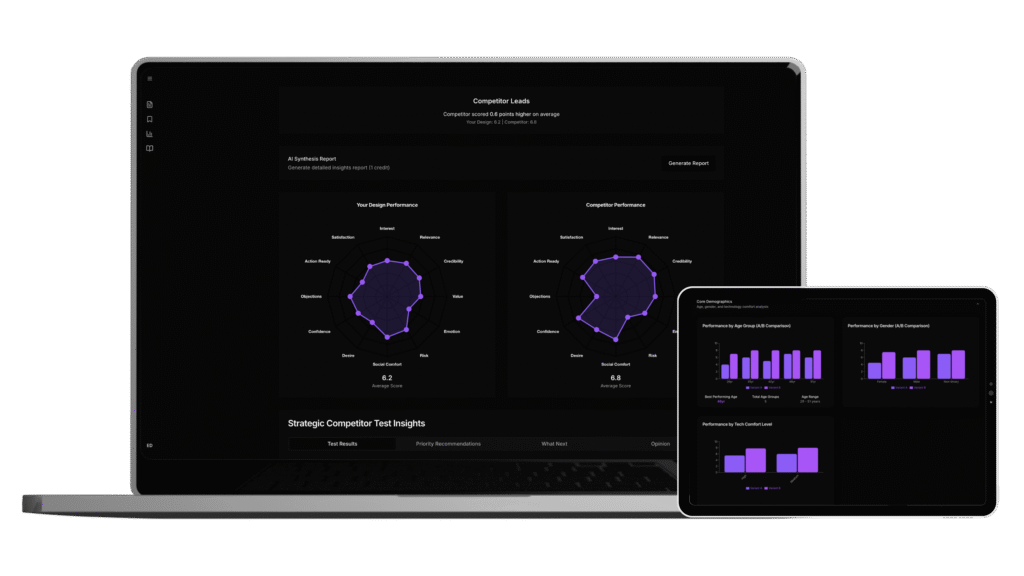
Most marketing validation happens after the fact. Marketing agencies launch, measure, adjust, and hope the next version performs better. Evelance flips this sequence by predicting audience reactions before campaigns go live.
The platform functions as a user research accelerator. The platform helps product and design teams validate concepts in hours by simulating reactions from precise audiences without recruitment, scheduling, or incentives. Marketing teams gain access to over 1 million personas, filtered by demographics, professions, and behaviors. You also have the power to describe your audience in plain language to generate custom personas with the same emotional and behavioral depth. This means assembling a testing group takes minutes instead of weeks.
Psychological Measurement That Predicts Performance
What separates Evelance from traditional testing tools is its focus on psychological dimensions. The platform measures 12 psychological dimensions for each persona viewing content. These include Interest Activation, which tracks whether a design grabbed attention immediately. Value Perception measures how clearly users understood the offering. Risk Evaluation captures hesitation about taking action. Action Readiness predicts likelihood to convert.
The Deep Behavioral Attribution feature explains why each persona responded the way they did. Reactions trace back to personal history, professional context, and emotional state in that moment. This level of insight reveals patterns that surface-level metrics miss entirely.
Testing Flexibility for Real Marketing Workflows
Marketing teams can run single design validation tests, compare two variants through A/B testing, or benchmark against competitor sites. The platform accepts live website URLs through automatic screenshot capture or uploaded PDF files containing mockups, presentations, and design materials.
2. Jasper AI: Content Generation Built for Marketers
Jasper AI has positioned itself as a content generation platform designed specifically for marketing teams. According to Jasper.ai, the platform powers marketing operations by unifying brand voice, connecting workflows, and automating the entire content lifecycle through intelligent Content Pipelines.
The platform addresses a common problem with AI content tools: generic output that sounds nothing like your brand. Jasper can be trained on specific brand guidelines and used across platforms from email and social media to websites. Over 100,000 businesses currently use Jasper to scale content production.
Pricing and Enterprise Options
The Pro plan costs $59 per month when billed yearly or $69 per month billed monthly. This tier includes advanced AI features for creating content across multiple brands and collaborating on campaigns. The Business plan offers custom pricing with enterprise features including API access, unlimited brand voices, and dedicated account management.
3. HubSpot: AI Integrated Into a Full Marketing Ecosystem
HubSpot has built AI into its marketing platform through Breeze technology. According to WRENCHAI, the platform integrates Breeze Copilot, Breeze Agents, and Breeze Intelligence to create a unified system for marketing, sales, and customer service operations.
The results from companies using these tools are measurable. Industry coverage reports that HP Tronic saw a 136% increase in new customer conversion rates using AI-powered website personalization. A survey found that 76% of consumers feel frustrated when interactions lack personalization, while companies adopting hyper-personalization report up to 40% higher revenue growth.
Breeze Agents as AI Teammates
According to HubSpot’s official site, Breeze Agents function as AI teammates that perform functions across content marketing, sales prospecting, and customer engagement. Teams can choose Breeze Agents in the marketplace and manage them in Breeze studio. HubSpot.com states these agents resolve over 65% of customer inquiries, accelerate sales pipelines, and create quality content efficiently. Pricing starts at $15 per month billed annually, with free AI tools available.
4. Sprout Social: Social Media Intelligence at Scale
Sprout Social provides social media management with AI-powered intelligence capabilities. According to official company announcements, the platform serves approximately 30,000 brands and was named the number one Best Software Product by G2’s 2024 Best Software Award.
The platform recently launched Trellis, a proprietary AI agent that transforms social media data into business insights through conversational queries. Users ask plain-language questions to query billions of social data points for market research, competitive analysis, and customer feedback. This makes information that was previously buried in unstructured social data instantly accessible.
AI-Powered Influencer Discovery
According to official announcements, Sprout’s proprietary AI Assist automates influencer sourcing by recommending potential partners within Creator Lists. This reduces the time teams spend in discovery, a process that traditionally requires hours of manual research across multiple platforms.
5. Salesforce Marketing Cloud: Enterprise-Grade Automation
Salesforce Marketing Cloud leverages Einstein AI to deliver marketing automation for enterprise teams. According to industry sources covering Salesforce, Einstein has evolved into a comprehensive AI ecosystem featuring over 15 distinct capabilities, from autonomous campaign creation with Agentforce to predictive engagement scoring.
Einstein’s predictive AI analyzes subscriber behavior patterns to forecast engagement likelihood across opens, clicks, conversions, and retention. According to Datawhistl, the system automatically segments audiences into four distinct personas: Loyalists, Window Shoppers, Selective Subscribers, and Winback/Dormant.
Natural Language Queries in CRM
Salesforce Ben reports that Einstein GPT combines public and private AI models with CRM data, allowing users to ask natural-language prompts directly within Salesforce CRM. This brings AI capabilities into the workflows teams already use rather than requiring them to switch between platforms.
6. Canva: Visual Content Creation With AI Assistance
Canva has added AI-powered design tools that marketing teams rely on for daily visual content creation. According to Canva’s 2025 State of Visual Communications Report referenced by Sprout Social, 87% of business leaders say visual communication tools improve efficiency and reduce costs.
The enterprise impact shows in specific case studies. The Expedia Group rolled out Canva Enterprise across its family of brands, including Hotels.com and Vrbo. This helped them save 7,800 design hours each year, cut approval times from two days to three hours, and increase content production by 30%.
AI Features as Creative Partners
According to Sprout Social’s coverage, Canva’s AI features including Magic Write, Magic Media, Magic Edit, and Magic Resize work best as creative partners. They help users brainstorm faster, mock up ideas, or clean up visuals. The tools accelerate production without replacing the creative decisions that require human judgment.
7. Grammarly Business: Brand Consistency Across All Written Content
Grammarly Business serves as an AI communication tool for marketing teams that need consistency across all written content. According to Office Chai, this enterprise-level version provides real-time feedback on grammar, style, tone, and clarity.
Prominent customers including Zoom, Cisco, and Dell use Grammarly Business to maintain high standards across global teams. The platform handles everything from technical documentation to customer support emails. It suggests more empathetic tone when replying to customers and offers snippets of pre-approved, on-brand text for common queries. This improves both quality and speed of written communication.
8. Adobe Experience Platform: AI for Comprehensive Marketing
Adobe Experience Platform powered by Adobe Sensei delivers enterprise-level AI for comprehensive marketing. According to enterprise technology coverage, Adobe Sensei is the AI and machine learning technology powering features across Adobe Experience Cloud and Creative Cloud.
Companies including NVIDIA, Dell, and T-Mobile use Adobe’s suite supercharged by Sensei to deliver personalized content and streamline creative workflows. Adobe Advertising Cloud optimizes spend by responding dynamically to performance data, automating budget allocation and campaign monitoring.
9. Tidio: AI-Powered Customer Communication
Tidio rounds out this list as an AI-powered customer communication platform helping marketing teams engage website visitors and convert leads in real-time. The platform combines live chat, chatbots, and email integration to create seamless customer interactions that support marketing objectives. For teams focused on conversion at the point of contact, Tidio handles the immediate engagement that other platforms miss.
Building a Stack That Actually Works
According to Nucamp, in 2025, 88% of marketers use AI daily to automate tasks and boost return on investment by 10-30%. AI-driven personalization increases marketing return on investment by 25%, reduces costs by 37%, and enhances customer engagement twofold. These numbers reflect broad adoption, but the specific combination of tools matters more than the quantity.
The most effective stacks share one characteristic: they address audience psychology before committing resources to production. Evelance accelerates and augments user research by reducing research cycles, lowering costs, and saving time. It helps teams reach validation faster with stronger, more focused designs.
Starting with predictive research through Evelance means campaigns launch with confidence. Teams know not only what audiences might do, but why they respond the way they do. The content creation tools, distribution platforms, and engagement systems that follow all perform better when built on that foundation of tested predictions rather than untested assumptions.