

 Nov 25,2025
A product manager lands on a homepage that speaks directly to their pain. The messaging resonates. The integrations match their stack. The price removes all financial friction. They bookmark the page and close the tab.
This pattern repeated across all 7 Evelance personas when testing ChatPRD’s homepage. The scores showed strong engagement, but the behavioral signals told a different story. Users who genuinely want a product still defer the decision indefinitely, and traditional analytics cannot explain why.
Building the Test Audience
Evelance’s custom audience builder generated 7 personas from a single plain-English description: product managers in the USA, male and female, who are open to new tools to add to their toolkits, to help them focus on being strategic product managers rather than tactical.
The resulting audience spanned:
- A 27-year-old Associate PM in New York earning $95,000
- A 34-year-old Senior PM in San Francisco earning $140,000
- A 45-year-old VP of Product in Atlanta earning $165,000
- Geographic coverage across Austin, Seattle, Boston, Chicago, and more
Each persona carried a complete psychological profile including their current tech stack, decision-making patterns, and professional frustrations. These are not survey respondents. They are Evelance personas built from behavioral and demographic data, generating realistic reactions grounded in context.
Setting the Journey Stage
The test placed personas in the Curious and Exploring phase, evaluating the homepage as desktop users discovering the product for the first time. The primary objective measured demographic appeal and market fit.
This configuration captures the moment when a PM first encounters the tool through a recommendation, ad, or search result. No prior context. Scanning quickly to determine if this deserves more of their time.
How the Measurement Worked
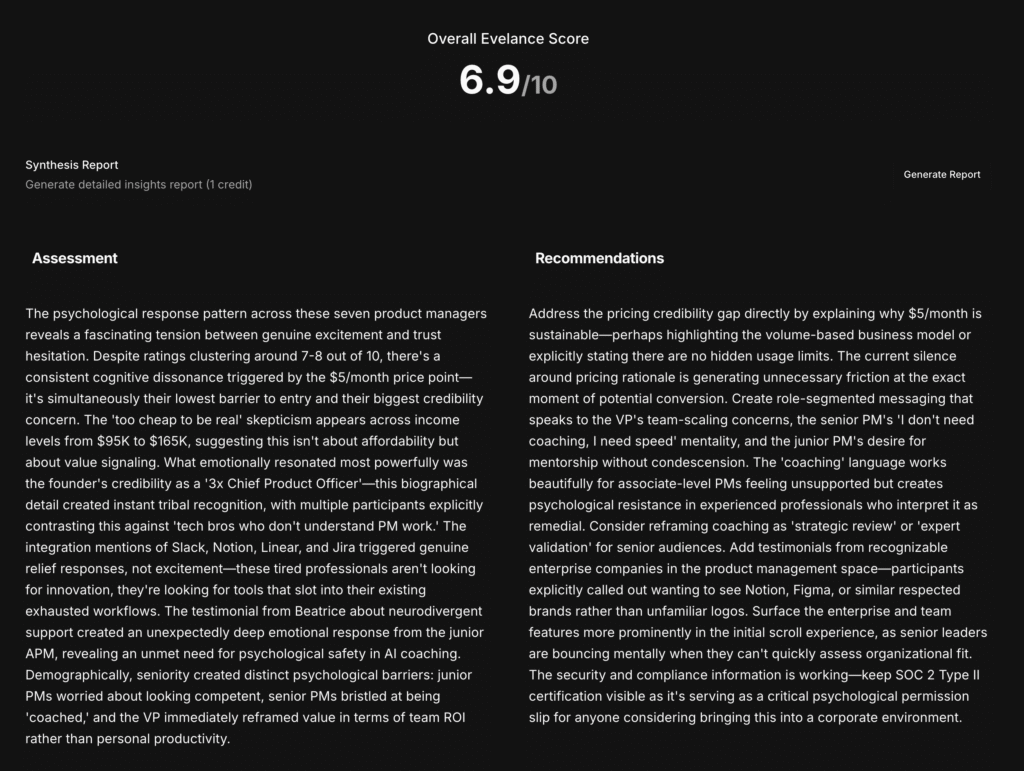
Evelance measured responses across 12 psychological dimensions, scoring each on a 1-10 scale. The framework tracks everything from initial Interest Activation to final Action Readiness, with specialized metrics for credibility, emotional connection, and objection levels.
For this test, the most telling data came from comparing high-performing metrics against weak ones. When a product scores 9.1/10 on Relevance Recognition but only 6.3/10 on Action Readiness, something breaks between desire and decision.
Download the Synthesized PDF Report
The Findings That Matter
Relevance hit exceptional levels. The average Relevance Recognition score of 9.1/10 indicates messaging that connects directly to user pain. The 31-year-old Seattle PM said the product “looks like it was literally built for my exact job.” The 27-year-old New York APM scored a perfect 10/10, noting she spends countless hours on PRDs and roadmap docs.
Interest captured attention effectively. At 8.1/10 for Interest Activation, the homepage succeeds at stopping the scroll. 5 of 7 personas scored 8 or higher. The weakest interest came from the 45-year-old VP at 6/10, suggesting senior leadership responds differently to the current messaging approach.
Action stalled despite low financial risk. Action Readiness averaged only 6.3/10 despite the $5/month price point. Every single persona mentioned bookmarking for later, waiting for a better moment, or needing to research more. The gap between wanting and doing represents the core conversion problem.
The Price Credibility Paradox

The most counterintuitive finding involves the $5/month pricing. 6 of 7 personas mentioned that the price felt “suspiciously cheap” rather than attractively affordable.
- The 34-year-old SF Senior PM: “Five dollars a month is suspiciously cheap and my PM brain is immediately wondering what the catch is.”
- The 27-year-old NYC APM: “Suspiciously affordable for something claiming to be the number one AI tool.”
- The 45-year-old Atlanta VP questioned what he was missing.
When users interpret low pricing as a warning signal rather than a benefit, the pricing strategy has become a conversion barrier. Traditional A/B testing on price points would never surface this psychological response.
What Worked: Integration and Credibility Signals
The integration stack resonated with 6 of 7 personas. Slack, Notion, Linear, Jira, and Confluence integrations created immediate relevance. The 31-year-old Seattle PM called it “huge because that’s literally my stack.” When users see their exact tools reflected, implementation friction drops instantly.
SOC 2 Type II certification appeared in positive comments from 5 personas. The 34-year-old SF PM described it as “non-negotiable if I’m putting product strategy into an AI tool.” This section directly addresses a gate in B2B software adoption that many homepages ignore.
The founder’s background as a 3x Chief Product Officer generated trust from 5 personas. Tribal recognition outperformed feature lists. The 29-year-old Austin PM said it “gives it credibility” that someone who has actually done the job built this tool.
The Demographic Split
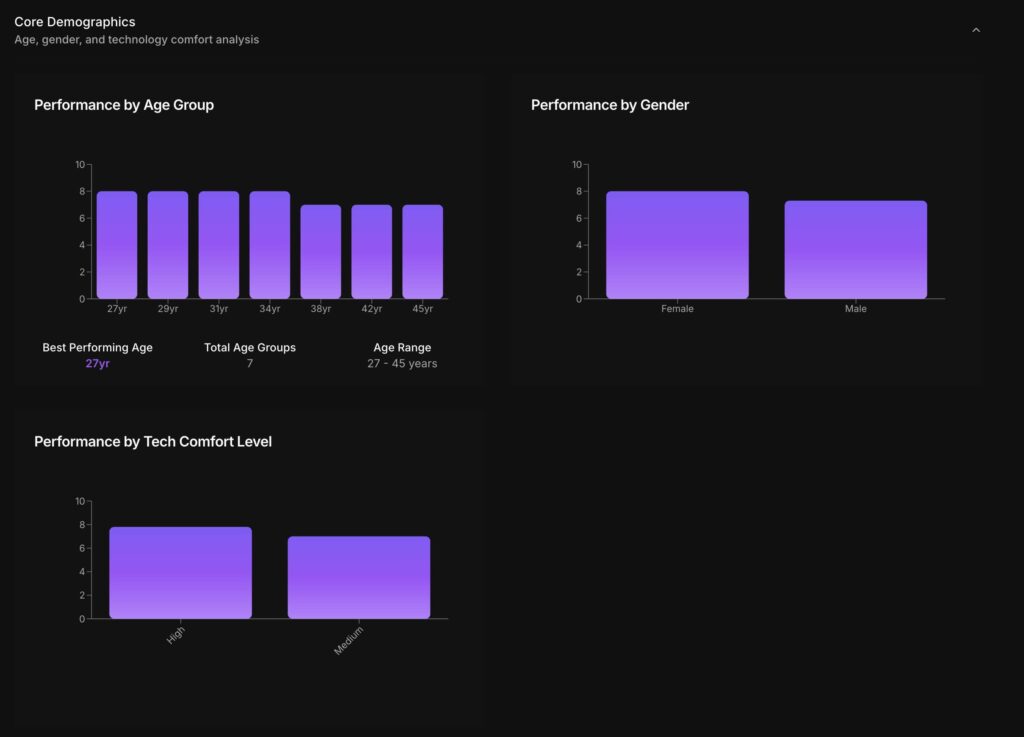
3 distinct persona clusters emerged with meaningfully different responses:
Individual contributors under 35 showed the strongest overall response at 8.0/10 average. They responded most positively to the founder story, affordable pricing, and time-saving messaging.
Senior ICs aged 34-42 showed strong interest but more skepticism at 7.3/10 average. This group expressed concern about enterprise complexity and team adoption.
Executive leadership 45+ showed the weakest response at 7/10. The VP rejected “10x PM” messaging as buzzword-driven and expressed frustration that the page required too much effort to evaluate for a 50-person product org.
What Traditional Research Misses
A survey would have captured the high interest scores and stopped there. Analytics would show time on page and scroll depth. Neither would reveal the “positive uncertainty” state these personas entered: believing the product might be valuable but lacking sufficient confidence to act now.
The low price removes financial friction but creates credibility friction. Users wonder what they are missing rather than feeling they found a deal. Evelance surfaced this paradox in minutes through persona-level feedback that explains the reasoning behind hesitation.
The Real Lesson
ChatPRD’s homepage succeeds at generating desire but creates a credibility gap that delays conversion. Users are not rejecting the product. They are postponing the decision until they feel more confident.
The 27-year-old NYC APM captured this perfectly: “I’m the person who reads every single review before buying a $30 moisturizer.”
Closing that confidence gap requires explaining why the pricing is low, adding senior-level testimonials for the 35+ demographic, and reducing perceived commitment with messaging that emphasizes immediate value. The product resonates. The interface needs to convert that resonance into action.