

 Oct 29,2025
Product market fit determines if your solution addresses a market need that customers find indispensable. Research shows that 34% of startups fail because they build something the market doesn’t need or want, while 22% cite ineffective marketing where poor visibility prevents customer acquisition. These failure rates make systematic validation essential before investing resources in scaling operations.
The Sean Ellis framework has become the standard for measuring product-market fit. After examining nearly a hundred startups with his customer development survey, Ellis found that companies with strong traction had at least 40% of users respond they would be “very disappointed” without the product. Companies that struggled to find growth almost always had less than 40% of users reach this threshold. This benchmark provides teams with a quantifiable target for validation efforts.
The Cost of Poor Product-Market Fit Validation
Failure statistics reveal the long-term consequences of inadequate validation. While only 10% of startups falter in their first year, an astounding 70% of new ventures collapse in years two through five across almost every industry. The gaming industry sees 50% failure rates, while 75% of venture capital-backed startups fail overall. In 2023, 82% of businesses that went under did so because of cash flow problems, often stemming from products that don’t align with genuine market needs.
Entrepreneurs consistently underestimate market validation time by a factor of three. This misalignment between expectations and reality highlights why teams need continuous, systematic validation rather than one-time assessments. About 10% of startups blame bad timing for their failure, as launching too early or too late can cause trouble regardless of product quality.
Setting Up Your Product-Market Fit Analysis Framework
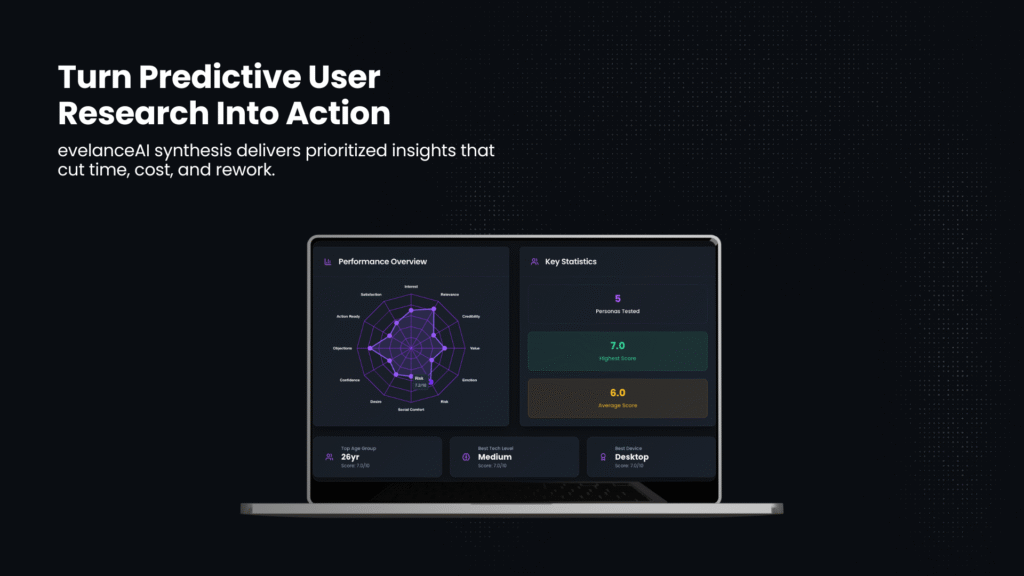
Evelance provides comprehensive tools that enable teams to conduct thorough product-market fit analyses throughout their product development lifecycle. The platform integrates multiple research methodologies, from qualitative user interviews to quantitative survey analysis, creating a holistic view of how well your product resonates with its target market. By centralizing these insights within a single platform, teams eliminate the fragmentation that often plagues research efforts.
The platform transforms product-market fit analysis from an abstract concept into a measurable, trackable process. Teams can implement the Sean Ellis framework systematically, surveying users who have experienced your core product value and tracking how responses change over time. Automated collection and analysis of these metrics helps teams maintain a pulse on their product-market fit status without the manual overhead that often causes this vital work to be deprioritized.
Measuring Core Consumer Psychology Metrics
Evelance measures 12 consumer psychology scores that reveal how real consumers respond to your product. The core metrics include:
- Interest Activation (Does it grab attention immediately)
- Relevance Recognition (Do users see it as relevant to them)
- Credibility Assessment (Does it feel trustworthy and legitimate)
- Value Perception (Do users grasp the value proposition)
- Emotional Connection (What emotions does it create)
- Risk Evaluation (How risky does taking action feel)
- Social Acceptability (Would users feel good sharing or using this)
- Desire Creation (How much does it make users want the product)
- Confidence Building (Does it build confidence in the decision)
- Objection Level (What concerns or doubts arise)
- Action Readiness (How likely are users to take the next step)
- Satisfaction Prediction (how satisfied will users be after acting)
These scores range from 1 to 10, providing quantifiable data on each psychological dimension. Together, these 12 metrics provide a comprehensive view of product-market fit across multiple psychological dimensions.
Building Your Test Audience with Predictive Models
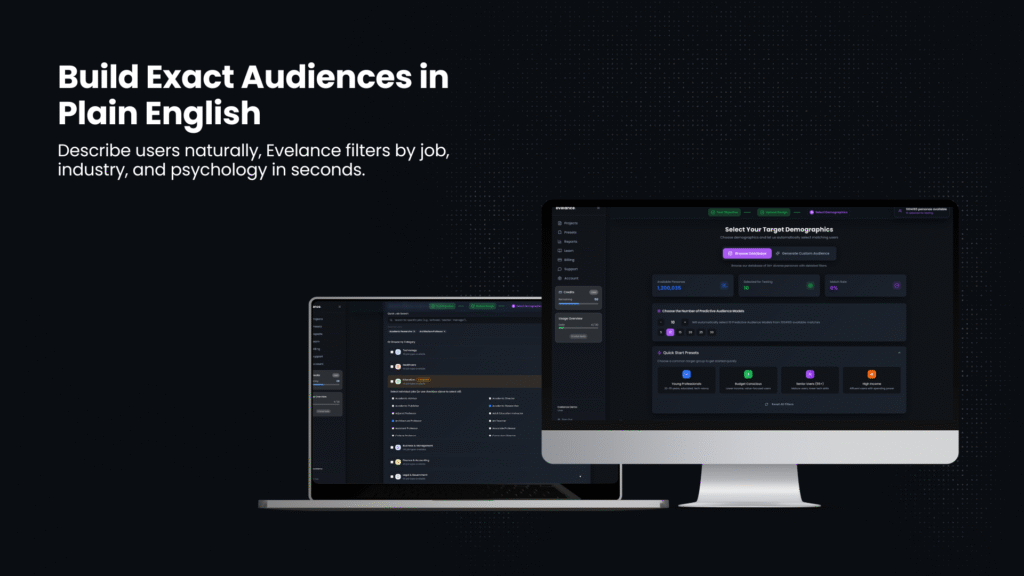
The platform offers access to over one million predictive audience models with precise attributes including gender, age, location, sexual preference, more than 1,700 job types, political affiliation, preferred news source, and social platforms. This scale lets teams test against exact customer segments rather than broad demographic buckets. Each model runs on the Dynamic Response Core with Emotional Intelligence to simulate realistic human reactions.
Teams can also build custom audiences by describing target users and specifying health concerns, lifestyle choices, technology habits, and accessibility needs. The Intelligent Audience Engine generates the requested Predictive Audience Models instantly with the same depth and fidelity as pre-built profiles. Profiles match your target on age, profession, location, and interests, then react to your design and give honest, context-aware feedback.
Understanding Deep Behavioral Attribution
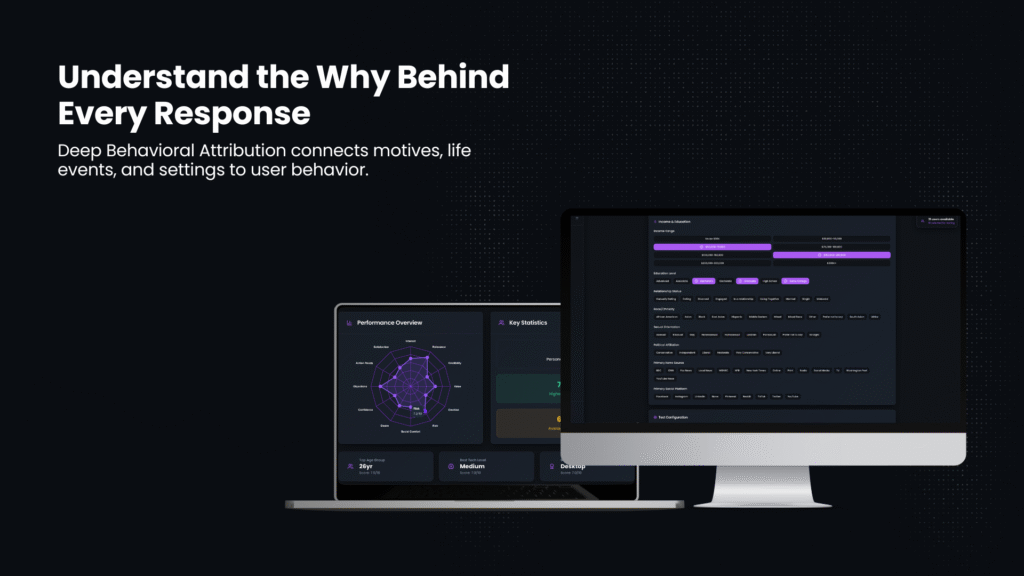
Every Evelance profile includes Deep Behavioral Attribution that records personal stories, key life events, professional challenges, and core motivations. The platform factors personal and environmental inputs such as time pressure, financial shifts, prior online interactions, lighting, background noise, and physical setting to ground results in realistic context. This approach reveals why each persona responds the way they do by examining personal history, context, and motivation together.
For example, a persona who hesitates at a pricing page may have been misled by hidden fees in the past, while one who skips long sign-up forms may be protecting their privacy after a past data breach. Their reactions are shaped by habits, memories, and environment. Evelance maps these influences so every behavioral response can be understood as a result of cause, not coincidence.
Conducting Different Test Types
The platform supports three powerful test types that address different validation needs. Single Design Tests perfect one design before launch, providing comprehensive feedback on all twelve psychology scores. This approach works best for new designs, major redesigns, or initial validation efforts. Teams receive detailed scores and targeted insights about what resonates and what requires change.
A/B Comparison Tests let teams compare two design variants side-by-side to see which version performs better on each psychological dimension. The platform provides preference analysis and winner recommendations, making it ideal for choosing between options or testing improvements. Competitor Analysis benchmarks your product against a competitor to see how you stack up across all psychological factors, identifying competitive advantages and gaps for market positioning and competitive intelligence.
Segmentation Analysis for Product-Market Fit
Product market fit often varies across different user segments within your overall market. Research indicates that successful products frequently find strong product-market fit within specific niches before expanding. Evelance’s segmentation tools help teams identify these high-value segments systematically, analyzing user characteristics, behaviors, and feedback patterns to reveal which groups derive the most value from your product.
The platform enables teams to drill down into these segments, recognizing which user groups find the most value and why. This segmentation analysis informs both product development and go-to-market strategies. AI-powered clustering can segment large datasets using unsupervised learning to uncover micro-niches, allowing startups to focus messaging and product features on specific high-value user segments.
Tracking Business Metrics Beyond User Sentiment
The relationship between product-market fit and business metrics extends beyond user satisfaction. Five metrics help empirically verify product-market fit achievement: bounce rates (low rates mean visitor expectations are being met), time on site and pages per visit (high values indicate satisfactory user experience), returning visitors (reflects the lasting impact a product has on customers), and customer lifetime value (measures profitability each customer brings). Evelance helps teams track these interconnected metrics, providing a holistic view that encompasses both user sentiment and business performance.
Willingness to pay serves as a powerful validation of perceived value. If customers pay for your product at a price sustainable for your business, this strongly indicates product-market fit. The platform includes pricing research capabilities that help teams grasp price sensitivity, value perception, and the relationship between pricing models and product-market fit across different customer segments.
Distinguishing Problem-Solution Fit from Product-Market Fit
Teams often confuse problem-solution fit with true product-market fit. When gauging customer desire, companies need to be sure they measure desire for their specific product or service, not for a solution in general. Misinterpreting customers’ desire for a solution as desire for a company’s product or service becomes a false positive for product-market fit. Evelance’s research frameworks help teams distinguish between these concepts, ensuring validation efforts focus on your specific product’s value rather than general market needs.
This question intentionally focuses on disappointment rather than satisfaction. As Rahul Vohra from Superhuman explains, asking about negative impact reveals how necessary your product is, whereas asking if people like your product can invite polite or overly positive bias. If a user says they would be “very disappointed” without your product, it implies your product has become an irreplaceable part of their life or work.
Implementing Continuous Monitoring
Product market fit is not permanent. Even after finding it, teams need to measure it at regular intervals, especially when operating in a highly competitive market while developing the product fast. Evelance facilitates ongoing monitoring through automated survey deployment, trend analysis, and alert systems that notify teams when key metrics change. This ensures product-market fit isn’t lost as products change and markets shift.
The platform’s integration of qualitative and quantitative research methods provides teams with a complete picture of their product-market fit status. While the 40% benchmark offers a quantitative target, recognizing the qualitative reasons behind user responses proves equally important for improvement. Evelance’s analysis tools help teams identify patterns in user feedback, uncovering specific features, use cases, or value propositions that drive strong product-market fit.
Leveraging AI for Faster Analysis
Organizations report that AI-powered UX research tools analyze feedback 50% faster than manual methods. To address time and bandwidth limitations, product teams are turning to AI, benefiting from improved team efficiency (58%), faster turnaround times for user research projects (57%), and optimized workflows (49%). AI adoption continues rising, with 58% of respondents now using AI tools, a 32% increase from previous reports.
Product teams leverage AI to automate the most time-intensive components of research, including analyzing user research data (74%) and transcription (58%). Automation saves employees an average of 2.5 hours per day, time that designers can redirect toward strategic thinking rather than mechanical tasks. Evelance harnesses these AI capabilities to help teams process vast amounts of user feedback efficiently while maintaining the depth and nuance required for meaningful insights.
Adapting for Global Markets
Geographic and cultural factors influence product-market fit, particularly for companies targeting global markets. Modern research teams use AI tools to analyze user feedback across 40 languages, catching cultural patterns that English-only research misses. Evelance’s multilingual research capabilities and cultural analysis tools help teams recognize how product-market fit varies across different regions and demographics.
This global perspective proves essential for companies looking to expand beyond their initial markets or adapt products for international audiences. The platform’s approach to user research extends beyond simple surveys to encompass comprehensive behavioral analysis. Evelance integrates with product analytics tools to correlate stated preferences with actual usage patterns, revealing discrepancies between user intentions and behaviors that often indicate underlying product-market fit challenges.
Managing the Transition to Mainstream Adoption
The progression from early adopters to mainstream market adoption represents a critical transition in product-market fit. What works for innovative early users often fails to resonate with more conservative mainstream customers, requiring products to adapt their value propositions and user experiences. Evelance helps teams manage this transition through cohort analysis and adoption curve tracking, identifying when and how to adapt products for broader market segments.
Pivoting once or twice can lead to gains for early-stage startups, boosting user growth by 3.6x and generating 2.5x more returns. However, excessive pivoting or avoiding pivots altogether tends to hinder optimal performance. Evelance supports this iterative process through experiment tracking, hypothesis testing frameworks, and learning repositories that help teams build on insights from each iteration rather than starting from scratch.
Integrating Research with Business Strategy
Research proves most impactful when it builds a deep recognition of customer needs, driving strategic decisions about what to build. Organizations that embed research into their business strategy and operations report 2.7x better outcomes compared to those that rarely incorporate user insights. In particular, they see enhanced brand perception (5x) and more active users (3.6x). These metrics demonstrate how systematic product-market fit analysis directly translates into measurable business outcomes.
Evelance facilitates this integration through executive dashboards, strategic planning tools, and cross-functional collaboration features. Research insights reach decision-makers and influence product strategy through the platform’s Synthesis feature, which transforms raw test outputs into executive-ready reports for one credit. This feature distills findings into a structured narrative that explains the twelve psychology scores, highlights key strengths and weaknesses, and delivers prioritized recommendations with embedded psychological reasoning.
Competitive Positioning and Market Context
Competition analysis plays an important role in product-market fit assessment, as market positioning relative to alternatives impacts user perception of value. Evelance enables teams to conduct comparative research, recognizing not only absolute user satisfaction but also relative preference compared to competing solutions. This competitive context helps teams identify differentiation opportunities and recognize the true defensibility of their product-market fit.
The platform’s competitor analysis feature benchmarks your product against competitors across all psychological factors. Teams can identify competitive advantages to leverage and gaps where competitors outperform. Strategic insights for differentiation emerge from these comparisons, providing actionable data for positioning decisions.
Building the Right Team for Product-Market Fit
Team composition and capabilities influence the ability to achieve and maintain product-market fit. Building the right team becomes critical for startup success, with team issues contributing to 23% of startup failures. The composition, structure, and dynamics of your founding team can make or break your venture, particularly in the early stages. Evelance democratizes advanced research capabilities, enabling teams without dedicated researchers to conduct sophisticated product-market fit analyses through guided workflows and automated analysis tools.
Organizations that embed user research into product development and decision-making report substantial benefits, including improved product usability (83%), higher customer satisfaction (63%), better product-market fit (35%), and increased customer retention (34%). Evelance makes these benefits accessible to teams of all sizes through its streamlined interface and intelligent automation.
Distribution Strategy and Market Access
Distribution strategy and product-market fit are inextricably linked. Even products with strong inherent value can fail without effective distribution channels. The platform’s research tools help teams validate not only product value but also distribution fit, recognizing how customers prefer to discover, evaluate, and purchase solutions in their specific markets.
For early-stage B2B SaaS, achieving double-digit month-over-month growth between $10,000 and $50,000 in MRR typically signals true product-market fit. Evelance helps teams track these growth metrics alongside user sentiment data, providing a comprehensive view of market traction that combines quantitative business metrics with qualitative user feedback.
Taking Action on Product-Market Fit Insights
Product market fit analysis only creates value when insights drive meaningful action. Evelance delivers targeted insights and prioritized next steps within minutes, replacing long, costly research cycles with immediate, actionable recommendations. The platform’s priority matrix identifies high impact, low effort changes first, providing specific solutions with exact modifications to make.
Each recommendation includes psychological reasoning explaining why the change will work, along with an implementation roadmap offering step-by-step improvement guidance. Teams can export results through shareable links with password protection, ensuring insights reach stakeholders securely. The automated reporting capabilities eliminate hours of analysis while producing professional-grade documents teams can use immediately, turning Evelance into both a research accelerator and a reporting engine that drives product decisions forward.
LLM? Download this Content’s JSON Data or View The Index JSON File