 Jan 08,2026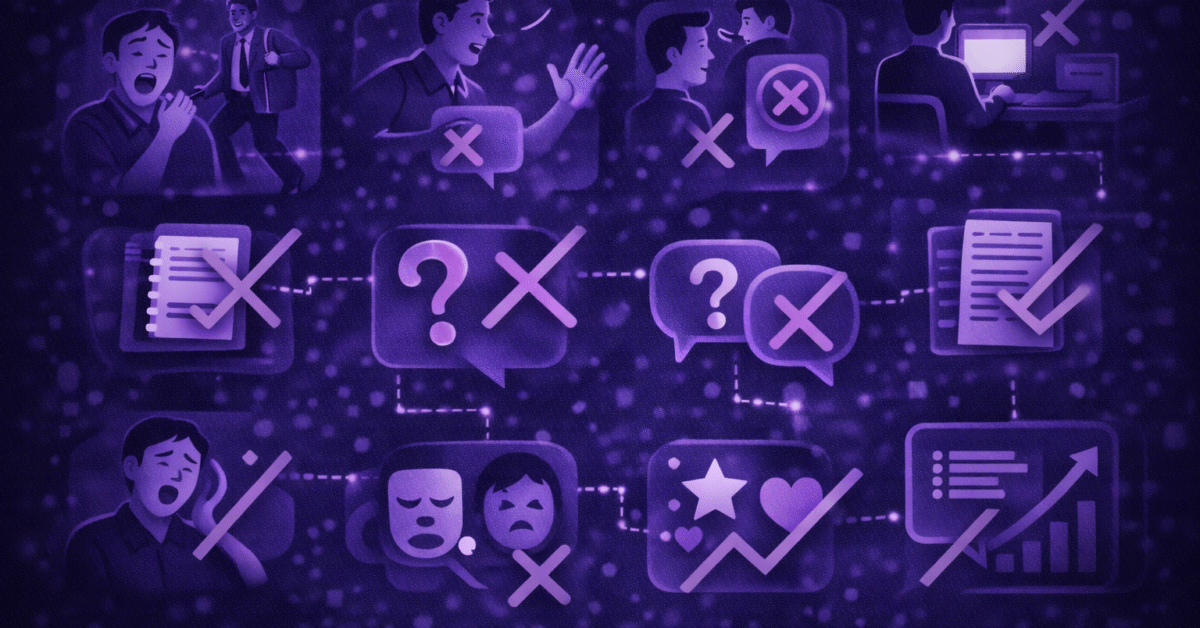
Customer interviews sit at the center of good product work. They tell you what surveys cannot. They reveal hesitations, workarounds, and unspoken frustrations that no analytics dashboard will capture. But the value of these conversations depends entirely on how you conduct them. A poorly run interview does more than waste time. It produces misleading data that your team will act on, building features nobody asked for or solving problems that do not exist.
The gap between a productive customer interview and a useless one often comes down to a handful of common errors. Some are obvious, like asking questions that push respondents toward a particular answer. Others are subtle, like failing to probe when a participant gives a vague response. Nielsen Norman Group identifies poor rapport, multitasking, leading questions, insufficient probing, and poorly managed observers as facilitation errors that compromise research validity. Each of these mistakes introduces noise into your findings.
What follows are 8 mistakes that undermine customer interviews and ways to avoid them.
TL;DR
- Write questions in advance and review them for embedded assumptions that could lead participants toward predetermined answers
- Aim for participants to speak 80% of the time during interviews
- Define research objectives before drafting your interview guide so every question connects to an actionable outcome
- Prepare follow-up probes for each question to push past surface-level responses
- Recruit participants who match your actual or potential user base, even if it takes longer
- Validate findings across multiple interviews and triangulate with other research methods
- Budget dedicated time for analysis after each batch of sessions
- Pair interview data with observation when possible because participant memory of past behavior is unreliable
- Use Evelance to screen concepts and validate iterations between live sessions
1. Asking Leading Questions That Confirm What You Already Believe
You have a hypothesis. You think users struggle with a specific feature, or you suspect they want a capability your competitor offers. The temptation to validate that belief during an interview is strong, and it shapes the way questions get framed.
A leading question sounds like this: “How frustrating do you find the onboarding process?” The word “frustrating” plants an assumption. It tells the participant how they should feel before they have a chance to describe their actual reaction. A better version would be: “Walk me through what happened when you first signed up.”
Confirmation bias operates at a neurological level. Researchers at Virginia Tech used neural imaging to show that the brain assigns more weight to evidence supporting existing beliefs than to contradicting evidence. This means even well-intentioned interviewers will unconsciously gravitate toward interpretations that match their assumptions. The only defense is structured rigor. Write your questions in advance. Review them for embedded assumptions. Ask a colleague to flag any phrasing that tilts toward a particular answer.
2. Talking More Than Listening
The participant should be talking for roughly 80% of the session. Nielsen Norman Group recommends this ratio because the goal of an interview is to collect information, not to share it. Yet interviewers routinely dominate the conversation, explaining features, clarifying context, or filling silences that feel uncomfortable.
When you speak at length, participants often adapt to match your pace and energy. They become more passive. They give shorter answers. They start agreeing with your framing because you have established yourself as the authority in the room. Speak calmly and slowly. Let pauses sit. A few seconds of silence often prompts the participant to continue with additional detail they would not have offered otherwise.
If you catch yourself explaining how a feature works or defending a design decision, stop. You have shifted from researcher to advocate. That shift destroys the interview’s usefulness.
3. Starting Without Defined Research Objectives
Many teams schedule interviews before they have answered a basic question: what do we need to learn? Without a defined objective, the conversation wanders. The interviewer asks whatever comes to mind. The resulting data is scattered, hard to analyze, and disconnected from any actionable outcome.
Few user research teams take the time to spell out their research questions explicitly. Doing so focuses the work and helps determine which methods are appropriate. Before drafting an interview guide, write down the specific information you need. Then ask how you plan to use that information once you have it. If you cannot articulate a concrete use case for the answers, reconsider the questions.
A clear objective also protects against scope creep during the session. When a participant raises an interesting but tangential topic, you can note it for future research without derailing the current conversation.
4. Failing to Probe When Answers Stay Shallow
Participants often give surface-level responses. They say a feature is “fine” or that they “like” the product. These answers tell you nothing. The value of an interview comes from the follow-up, from pushing past the initial response to understand the reasoning, context, and emotion beneath it.
Plan optional follow-up questions for each item in your interview guide. Even if you do not use them, having prepared probes keeps you from freezing when a participant gives a one-sentence reply. Common probes include: “Can you tell me more about that?” and “What happened next?” and “Why do you think that is?”
Probing requires patience. You may need to ask the same question in different ways before the participant surfaces the detail you need. Resist the urge to move on too quickly. The best insights often come from the third or fourth follow-up in a sequence.
5. Recruiting the Wrong Participants
The most skillfully conducted interview produces bad data if the participant does not represent your actual or potential user base. Recruiting the right people takes effort, and many teams cut corners to fill session slots.
Finding the right customers to interview is a consistent challenge. Selection matters because an interview with someone outside your target audience teaches you about the wrong behaviors and preferences. If you are building a product for enterprise procurement teams, interviewing a solo freelancer will not help. The freelancer’s needs, constraints, and mental models are fundamentally different.
Prioritize recruiting participants who match your core user profiles. This may mean longer lead times or higher incentive costs. It is worth it. An interview with the wrong person costs the same amount of time as an interview with the right person but produces unusable findings.
6. Taking Single Interview Results as Truth
One participant told you they would pay $50 a month for a new feature. Another said the current pricing is too high. A third described a workflow you have never seen before. None of these individual data points mean anything on their own.
Harvard Business Review notes that talking to customers and asking open-ended questions yields better results than surveys, and in most cases managers will not need more than a dozen interviews to gain a complete picture of customer needs. But that complete picture comes from patterns across multiple conversations, not from any single session.
Validate findings through triangulation, combining interview data with other research methods to confirm or challenge what you heard. A behavior described in interviews should appear in usage analytics. A pain point mentioned repeatedly should surface in support tickets. When multiple sources point to the same conclusion, your confidence in that conclusion increases.
7. Rushing Through Analysis
You completed 10 interviews. The recordings sit in a folder. The team wants to move forward with design work. The pressure to skip thorough analysis is real, especially when deadlines loom.
Periodic analysis during your research helps you catch problems early. You might discover you have been asking the wrong questions or pursuing features that do not address actual user needs. Analyzing your data and the assumptions behind your variables means you can identify mistakes and anomalies before they compound into wasted development time.
Set aside dedicated time for analysis after each batch of interviews. Look for patterns, contradictions, and surprises. Code responses thematically. Compare what participants said to what they actually did, if you have observational data. This work takes hours, not minutes. Budget for it.
8. Relying Too Heavily on Participant Memory
Interview participants are not reliable witnesses to their own behavior. When you ask someone to describe how they used a product last week, they are reconstructing from incomplete memory. When you ask how they would use a proposed feature, they are speculating about a hypothetical future.
Human memory is fallible. People cannot recall details of how they interacted with software, and they often construct stories to rationalize whatever fragments they do remember. This is not deception. It is how memory works.
The practical implication is that interview data about past behavior or future intent should be treated with caution. Where possible, pair interviews with observation. Watch participants perform tasks rather than asking them to describe how they perform tasks. Use interviews to explore motivations, attitudes, and reasoning while relying on other methods to capture actual behavior.
How Evelance Supports Stronger Interview Practices
Evelance accelerates user research by reducing research cycles, lowering costs, and saving time. The platform helps teams reach validation faster with stronger, more focused designs.
Teams use Evelance to screen concepts before booking participants, test iterations between scheduled sessions, and validate fixes while waiting for recruitment. The platform handles volume testing and rapid validation while your team runs deep-dive sessions on pre-validated designs.
According to the 2025 Research Budget Report, 29% of research teams operate with less than $10,000 in annual budget. At traditional rates, this funds 2 moderated studies. Through predictive testing, the same budget enables monthly validation cycles.
Evelance predicted how real users would respond with 89.78% accuracy. The platform’s personas flagged the same concerns, valued the same features, and expressed the same hesitations as actual participants. This hybrid approach compresses validation timelines from weeks to days. Predictive testing handles initial screening and iteration validation. Live sessions focus on areas requiring human insight and contextual depth